 |
|
|||||||||||||||||||||||||
Compaq iPAQ 3650New design brims with innovation (April 2000 issue)
Gone, for example, is the thumbwheel on the left
side, replaced by a 5-way navigational disk that doubles as a speaker. I much
prefer the disk as I never managed to master the one-handed control all those
palm-size PC side buttons were supposed to facilitate. The audio recorder is
still on the right, properly placed for activation with your thumb. The on-off
switch is at the right front of the device so that you don't inadvertently turn
the unit off as you do, for example, on the Casio where the power switch sits
right next to the menu button and the rocker control.
In terms of size and
weight, the iPAQ represents a significant advance as well. Though the iPAQ
footprint is only slightly smaller than the 2100's, it looks and feels much
smaller. In fact, until you place them side by side, you'd swear the iPAQ is no
larger than a Palm V (it is). The iPAQ is also thinner than its predecessor (0.62
vs. 0.75 inches) and weight is down from nine to 6.4 ounces. You'll barely feel
this Pocket PC in your pocket. But the iPAQ is more than just a pretty face.
Compaq clearly put a lot of thought into this design and addressed a number of
shortcomings.
Take the screen: whereas the 2100 Series' indoor/outdoor readable
HR-TFT (high-reflective TFT) screen was a breakthrough in LCD technology, it was
also more of a compromise than many people were willing to make. While the
original Sharp-made HR-TFT was readable in the brightest sunlight it was rather
dim indoors. That's because the reflective screen needs a sidelight that simply
is no match for the bright, vibrant colors produced by standard TFTs. The
flipside, of course, is that even the brightest traditional TFT washes out
completely in direct sunlight, making the terrific Casio all but unusable
outdoors. To its credit, Compaq realized that a Pocket PC wouldn't be very useful
if you couldn't use it outdoors and stuck with HR-TFT screen technology. The
iPAQ's screen, however, is a much improved second generation design. It is made
by Sony instead of Sharp, and generates a vastly improved viewing experience. The
new screen still uses sidelighting but it is much, much brighter than that of the
2100 Series. There are five different brightness settingsÑall the way from power
save to super brightÑand an automatic setting that adjusts the screen via an
ambient light sensor. At its brightest setting, you can place an iPAQ side by
side with a Cassiopeia E-115 and see very little difference. Oh, the E-115's TFT
is still a bit brighter and more vibrant, but it is no longer a night and day
difference as it was comparing the Aero 2100 with a Cassiopeia E-105.
Outdoors,
the iPAQ has no competition. The picture literally glows in vibrant color whereas
the Jornada and the Casio simply turn invisible. Amazingly, the new iPAQ screen
also beats the 2100 outdoors. It is crisper and offers better contrast. This
screen is a real winner, but there are a couple of caveats. First, if all you
want is the best possible indoor multimedia experience, the iPAQ is still no
match for the E-115's TFT. Second, whereas the 2100's screen and digitizer had
almost glasslike smoothness and optics, the iPAQ's digitizer has a bit more
spring and distortion in it. Third, since the screen is sidelit, it has a much
narrower horizontal viewing angle (the vertical viewing angle is excellent) and a
pronounced fluorescent light effect when you look at it from the side. Finally,
for as of yet unknown reasons, the iPAQ supports "only" 4,096 colors compared to
both the Casio's and its own 2100 Series predecessor's 64k color. Poking through
the iPAQ's innards provides a possible explanation. The iPAQ uses a 206MHz
version of Intel's StrongARM SA1110 processor. This incredible little powerhouse
packs 2.5 million transistors and puts out 235 Dhrystone MIPS. It also has an
integrated LCD controller that supports several different color modes. There is a
256 color mode that uses a patented dithering algorithm to pick the proper 256
colors from a palette of 4,096 colors. If 4.096 colors are needed, the frame
buffer that picks the 256 colors is bypassed and the dither logic does the job
directly. If 16-bit color (i.e. 64k color) is required, both the buffer and the
logic are bypassed and the request is handled directly by the processor. A
possible explanation for the 4,096 color limitation is that full 64k color might
have eaten up an unacceptable part of the StrongARM's performance advantage.
Let's also address another design feature that has been met with, let's say,
mixed reactions. The iPAQ does not have a CF Card slot. Any and all connectivity
not built into the device comes via one of a selection of "expansion packs."
These packs are plastic sleeves that initially add either PC Card or Compact
Flash functionality, with promises of much more to come. Compaq also
differentiates between expansion packs that add functionality and style packs
that add covers or physical protection. At the Seattle Reviewer's Conference,
Compaq got heavy flak from the mainstream computer press for omitting at least a
CF Card slot. Myself, I can see both sides. While it appears that even the small
iPAQ housing could have accommodated a CF Card slot somewhere, it is possible to
live without one. The iPAQ has a built-in USB/serial connector for very fast
synchronization, so there is no need for a USB CF Card. However, if you intend to
use the iPAQ with a modem, it may seem a lot easier to simply pop a CF Card modem
into a slot than sliding the iPAQ into a CF Card jacket just so that you can plug
in your CF Card modem. Also, while I could probably live without ready access to
a modem, I do like to be able to pop in CF memory cards to back up data or use
programs that I don't need in internal memory. The basic iPAQ can't do that, and
keeping it in an expansion pack all the time gives up a good chunk of the size
and weight advantage the iPAQ has over the Pocket PC competition. Compaq may be
forced to add a CF Card slot in a future model of the iPAQ, but it's also
possible that the USB connector and expansion packs provide all the flexibility
most people will ever need. After all, millions of Palms have been sold despite
the lack of a CF Card slot. Also, expansion packs can accommodate full-size PC
Cards, something that the competition cannot do.
Compaq Windows CE devices have
always distinguished themselves with class-leading sound capabilities, and the
iPAQ is no exception. Though its major competition also offers a stereo output
jack, the Compaq's sound volume is significantly higher, both via speaker and via
output jack. The one drawback is that the iPAQ's frontal speaker sounds a bit
harsh and metallic. The HP and Casio can't match the iPAQ's volume, but sound
richer.
In terms of software, the iPAQ comes well equipped. In addition to the
standard Pocket PC software, there are some value-added utilities. Qstart lets
you group applications into categories, much like you could on the Newton. QMenu
and Qutility provide a host of diagnostic and system management tools.
Since the
iPAQ felt so quick, we were dying to run benchmark tests on it. Unfortunately,
bSQUARE's bUSEFUL Analyzer benchmark suite hadn't been adapted to the Pocket PC
yet. So for now we can only say that the iPAQ with its firebreathing StrongARM
processor feels like it is the fastest Pocket PC available. In a number of
informal performance tests it was consistently up to twice as fast as the
competition. While the StrongARM processor is actually quite energy efficient,
the stronger backlight would have taken its toll on a conventional Li-Ion battery
pack. As a result, the iPAQ is equipped with a Lithium-Polymer power source. That
is quite an accomplishment. Less than two years ago, Lithium-Polymer batteries
were still in the prototype stage and their cost prohibitive. Unlike most other
technologies, Lithium-Polymer batteries can be of almost any shape. In the iPAQ,
the battery is configured as a thin sheet with almost the same footprint as the
device itself. Lithium-polymer also doesn't leak, doesn't have a memory effect,
and doesn't contain any toxic metals. Compaq claims a battery life of up to 12
hours per charge. Since the battery is totally integrated into the iPAQ's design,
another question here is what you're going to do when the battery dies. According
to Lithium-Polymer specs that shouldn't happen for several years of average use,
but things do happen. -
|
||||||||||||||||||||||||||
|
[Homepage] All contents ©1995-2000 Pen Computing Magazine, Inc. All rights reserved. |
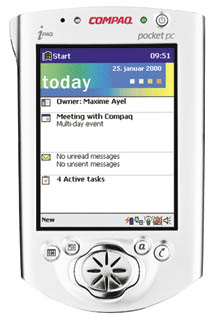 Of all the new Pocket PC hardware (or let's say of whatever little there is at
this point), the iPAQ is the most interesting by far, and perhaps also the most
controversial. I always thought Compaq's "old" Aero 2100 Series was quite
attractive, but compared to the iPAQ it looks big and clumsy. The iPAQ is
smaller, lighter, thinner, faster, brighterÑyou get the idea. And virtually every
change is one for the better.
Of all the new Pocket PC hardware (or let's say of whatever little there is at
this point), the iPAQ is the most interesting by far, and perhaps also the most
controversial. I always thought Compaq's "old" Aero 2100 Series was quite
attractive, but compared to the iPAQ it looks big and clumsy. The iPAQ is
smaller, lighter, thinner, faster, brighterÑyou get the idea. And virtually every
change is one for the better.